
Hilo, Part 5 of an Ongoing Series
August 2026
By Rosalinda Cruz, Founder of The Asor Collective
When I started this series, I thought I was writing about history.
I was wrong.
Hilo has traced Puerto Rican and Caribbean textile heritage across five centuries, from Taíno cotton cultivation and the craftswomen of Moca to the colonial labor economies that extracted value from Puerto Rican women’s hands without ever crediting them. Each part of this series has followed the same thread: a people whose knowledge, labor, and land have been systematically taken, repackaged, and sold, usually with the language of progress, development, and sustainability attached.
That story is not history. It is happening right now. In Cabo Rojo, Puerto Rico. And it is called Esencia.
The Through Line
Let me draw it clearly before we get into the present.
In Part 1 we established the personal frame: the grief that sent me looking, the family geography of Fajardo and Corozal, the two indigenous peoples whose histories meet in my ancestry. In Part 2 we traced the Taíno material culture, the adorned cotton textiles, the sacred cemís, the three surviving artifacts now held in European museums, two of them subject to active repatriation disputes. In Part 3 we followed the craftswomen of Moca, whose mundillo tradition survived colonialism because women passed it hand to hand across centuries. In Part 4 we arrived at the U.S. territorial era, where Puerto Rican women’s skilled labor was co-opted into a colonial export economy with no protections, no recognition, and no ownership over what they built, the same infrastructure that became the template for Operation Bootstrap.
The pattern across all of it is consistent. Puerto Rican people building things of value. Outside systems taking that value. The people who built it being made invisible in the official record.
Esencia is the current chapter of that same story.
What Forbes Said
On August 6th, 2026, Forbes published a piece calling Esencia “the Caribbean’s largest solar-powered luxury resort community” and framing it as a model for sustainable development in the region. Solar powered. Self-sufficient. Off the grid. Environmentally conscious. A gift to Puerto Rico.
I want to tell you what Forbes left out.
What You Need to Know
Esencia is a proposed $2.5 billion luxury mega-development planned for Cabo Rojo on the southwestern coast of Puerto Rico. 2,000 tropical acres. 3 miles of beachfront. 1,132 private residences priced between $2 million and $20 million. 520 hotel units. Two golf courses. A private airfield. A Mandarin Oriental, an Aman, and a Rosewood resort. A private city for the ultra-wealthy, built on land classified as Specially Protected Ecological Rustic Soil at both the federal and national levels.
The Puerto Rico Tourism Company has approved nearly $498 million in tax credits for the project. That is almost exactly what the developers claim they will give back to the local community over the entire life of the project.
Now here is what Forbes did not tell you.
Cabo Rojo is the municipality with the highest documented density of archaeological deposits on the entire island of Puerto Rico. The project sits on land containing more than 100 identified Taíno archaeological sites. Peer-reviewed research published in scientific journals has found the oldest human remains ever discovered in Puerto Rico at sites in Cabo Rojo, remains spanning a period of 500 to 1,000 years, indicating that the Taíno considered this place sacred enough to bury their ancestors there across many generations.
The United Confederation of Taíno People has formally opposed the project. Over 18 community and scientific organizations organized a people’s assembly in September 2024 and submitted 13 formal presentations. The Defend Cabo Rojo Coalition demanded citizen participation in the environmental review. That participation was denied. Construction was approved without a public hearing.
The developers say they will support archaeological digs and build a museum within the project’s borders. Let that sit for a moment. They want to excavate Taíno ancestral burial grounds, place the findings in a museum they own on land they control, and call it stewardship.
In Part 2 of this series we traced two of the three surviving Taíno cotton artifacts currently held in European museums: one in Vienna, one in Turin, one the subject of an active repatriation fight between the Dominican Republic and Italy. The argument we made there was simple: who owns the knowledge, the materials, the objects, the ancestors?
Esencia is asking the same question. And answering it the same way colonialism always has.
The Sustainability Argument
Yes, the developers claim Esencia will operate on solar power and its own water systems. This is the part of the Forbes story that sounds good if you do not ask the next question.
The next question is: for whom?
A private microgrid serving residences priced between $2 million and $20 million does not fix the failing public grid that Puerto Rican families depend on. After Hurricane Maria in 2017, Congress authorized $23 billion in disaster aid including at least $10 billion to restore the power grid. Years later, residents are still experiencing outages lasting days. Puerto Ricans already pay twice as much as mainland U.S. customers for electricity service that is fundamentally unreliable.
Cabo Rojo residents are already experiencing water shortages. And Esencia is projected to use between 1.25 and 1.5 million gallons of fresh water every single day. For golf courses. For luxury pools. For landscaped grounds. In a municipality where the people who actually live there cannot count on reliable water service.
A private water system does not solve the shortage for the fishermen, farmers, and families who will lose access to the ocean and the land they have worked for generations.
This is not a sustainability story. This is a greenwashing story. The language of environmental stewardship is being used to build a private city for the ultra-wealthy on Taíno sacred land, approved without public hearings, backed by nearly half a billion dollars in tax credits, in a community that already cannot get clean water or reliable electricity.
The sustainable fashion industry I work in does exactly the same thing when it repackages indigenous and traditional knowledge as luxury wellness and charges $400 for a linen shirt without crediting or compensating the communities whose fiber traditions and farming practices made that product possible. The mechanism is identical. The outcome is identical.
The knowledge and the land belong to the people who built the relationship with them. That is the argument this series has been making from the beginning. Esencia is the clearest current example of what happens when that argument is ignored.
The Land That Was Always There
In Part 4 of this series we traced the land reform of 1941 that gave Puerto Rican families the right to own the land they had worked as aggregados for sugar companies. We traced how my own grandparents, Julio Cruz García and Petra Roldán Rosa, became homeowners in Barrio Beltrán in Fajardo through that redistribution. The house is still in the family.
The land in Cabo Rojo that Esencia wants to build on was also always there. The Taíno buried their ancestors in it for a thousand years. The families of Cabo Rojo have fished its waters and farmed its soil for generations. The Specially Protected Ecological Rustic Soil designation exists specifically to prevent exactly this kind of development.
The approval was granted anyway. Without a public hearing. Without transparency. With nearly half a billion dollars in tax credits to a foreign development firm.
El pueblo sabe. El pueblo recuerda. El pueblo no va a desaparecer.
The people know. The people remember. The people will not disappear.
This Is What a Movement Looks Like
I want to close with something that happened on August 22nd, 2026.
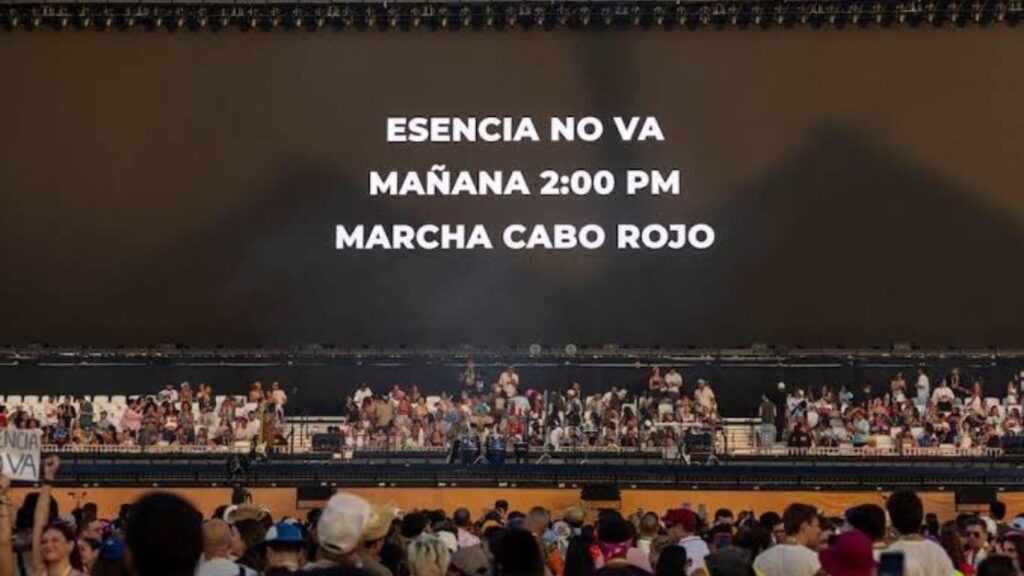
Bad Bunny closed his Debí Tirar Más Fotos World Tour at home, at Hiram Bithorn Stadium in San Juan, in front of tens of thousands of people. Before the show began, a message appeared on the screens: “ESENCIA NO VA. MAÑANA 2:00 PM. MARCHA CABO ROJO.”
He used the biggest stage of his career to call his people to action. He spoke directly about the water rationing and blackouts hitting the island, calling the situation a disaster. He said he came home to bring alegría, esperanza y fuerza, joy, hope, and strength, to defend Puerto Rico.
On Sunday August 23rd, people marched in Cabo Rojo.
This is how movements are built. Not only in formal organizing spaces, not only in petitions and legal filings and community assemblies, though all of those matter. Also in stadiums. Also in the moment a Puerto Rican artist looks out at his people and says: the island needs you, and here is where to show up.
The album Debí Tirar Más Fotos, which translates to I Should Have Taken More Photos, is itself an act of cultural preservation. A document of Puerto Rican life, community, and beauty, made precisely because those things are under threat. It is not a coincidence that the same artist, on the same tour, is pointing his audience toward Cabo Rojo and the Taíno ancestral land at risk of being bulldozed for luxury golf courses.
La música es el hilo. La marcha es la tela.
The music is the thread. The march is the fabric.
If Esencia is built as proposed, critics have been clear: we may see a Puerto Rico without Puerto Ricans. Colonial gentrification, the slow displacement of local communities through policies designed to attract wealthy outside investors, has been accelerating for a decade. Esencia is not the beginning. It is the latest and most visible chapter.
Follow @comiteesencia on Instagram for updates from the organizing coalition. Follow @defiende_caborojo for community voices from Cabo Rojo directly. Sign the petition at the link in their bio. If you bank with JPMorganChase, know that activists have formally called on them to cut ties with this project. Share this post. Forbes is publishing luxury travel pieces about this development. The Puerto Rican diaspora is the counter-narrative.
¡Esencia No Va! 🇵🇷
Part 6 of the Hilo series is coming. It begins at home, in Holyoke, in Springfield, in Amherst, and it asks what it means to keep pulling the thread when the thread keeps leading somewhere that matters.
Rosalinda Cruz is the founder of The Asor Collective, a sustainable fashion advisory and education practice based in North Carolina. She is currently developing Hilo*, a documentary exploring the ancestral textile traditions of Puerto Rico.*
A Note on Methodology:
The research informing this series moves through several layers of inquiry. It begins with cultural immersion, coursework, and the kind of observational knowing that comes from living inside a community and its history. It expands into archival aggregation, gathering documented sources, oral histories, and family narratives, with attention to the distinction between primary and secondary sources. It deepens through journalistic-level inquiry, including structured interviews with community practitioners, elders, scholars, and cultural workers, conducted in part through The Common Thread, my monthly long-form interview series. Where available, findings are grounded in peer-reviewed scholarship and institutionally documented sources, which are cited explicitly. Ancestral and community knowing is treated as evidence, not anecdote. It is sourced, named where possible, and held with the same care as any other form of documentation. This series does not claim to be academic research. It claims to be honest, sourced, and accountable to the communities it is about.
Sources referenced:
- Forbes, “Puerto Rico Is Getting The Caribbean’s Largest Solar-Powered Luxury Resort Community” (August 6, 2026)
- Black Agenda Report, “What is Esencia and What Will Happen to Puerto Rico If This Is Constructed?” (March 2025)
- Change.org / Defiende a Cabo Rojo Coalition, petition and formal opposition submissions (October 2024)
- United Confederation of Taíno People (UCTP), formal opposition statement (August 2024)
- LA Progressive, “Puerto Rico Is Not for Sale: Why the Fight Against Esencia Matters to Americans” (April 2026)
- Boston Review, “Carrying Water” (August 2026)
- The Indypendent, “NYC Puerto Ricans Call on JPMorganChase to Cut Ties with Luxury Mega-Resort Project” (April 2026)
- Science/AAAS, “Oldest Human Remains from Puerto Rico Contradict Idea of Simple Island Nomads” (April 2023)
- PLOS ONE, “Reconsidering the Lives of the Earliest Puerto Ricans: Mortuary Archaeology and Bioarchaeology of the Ortiz Site, Cabo Rojo” (2023)
- New England Public Media, “Springfield, Holyoke Honor Puerto Rican 65th Infantry Regiment, the Borinqueneers” (April 2022)