
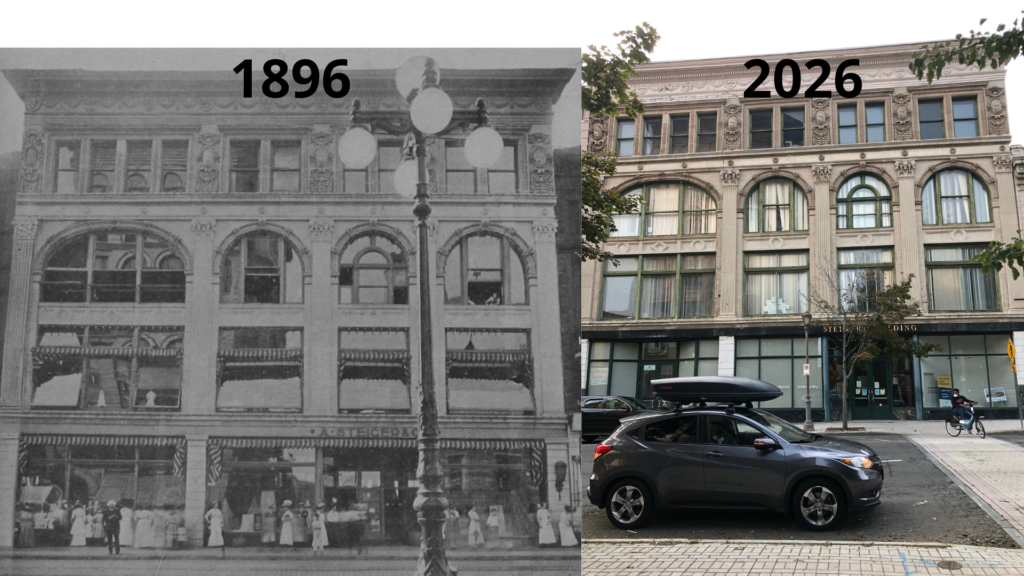
Hilo, Part 7 of an Ongoing Series
October 2026 Issue. By Rosalinda Cruz, Founder of The Asor Collective
Last month I promised we would step behind the curtain. This is that issue.
Part 6 was about the valley: the mills, the tobacco fields, and the Puerto Rican community that stayed. This one is smaller. It is about the sales floor, the fitting room, and the people on both sides of the curtain. Most of what I know about the industry and customer service, I learned there first.
The Steiger’s Way
I love retail. I say that plainly because the sustainability conversation usually casts retail as the villain, the place where overconsumption happens. I understand why, but that isn’t the whole truth.
In November 1991, at sixteen, I started my first holiday season at Steiger’s. I learned what everyone there called the Steiger’s Way, which really meant learning what good customer service is. I learned it side by side with Sue Warner, the mother of a childhood friend, who became my Yoda. She taught me the joy of retail, the art of gift wrapping, creative problem solving, and how to engage wholeheartedly with a stranger in an instant. We had a lot of fun together over the next three holiday seasons.
That is where I learned something I still teach founders. A good shopping experience creates an emotional connection. Done right, you are not buying a thing. You are buying a memory.
That kind of retail is harder to find now. It lives on at the retailers that still invest in service: a handful of department stores and larger brands I shop when they are at their best, and several well-run independent boutiques that never lost the thread. Every time I walk into a store that still does it the old way, I am transported back to the Hampshire Mall, taking comfort in the Steiger’s Way.
Retail also taught me never to judge a book by its cover. The person in sneakers and a sweatshirt may be the client who changes your whole season. The one dressed head to toe may just be passing the time. Everyone who walks through the door gets the same welcome.
And the most important area in any store is not the window or the cash wrap. It is the fitting room. Some of the most human conversations of my life have happened on the other side of a curtain.
I have sat with numerous women shopping for themselves for the first time after divorce, relearning what they liked with no one else’s opinion in the room. I have helped women find clothes that felt like them again after a mastectomy, and I watched them decide in the mirror that they were still themselves. I have been there for weddings, graduations, pregnancies, the new job, and the first day back.
People don’t only try on clothes in a fitting room. They try on who they are about to become while honoring their former selves.
Behind that curtain, you see the best of people and the worst of them, and it will toughen you up. Some of the most racist and degrading moments of my life happened there. A customer once dropped clothes on the floor in front of me and told me to pick them up. Without blinking an eye, I looked at her, smiled, and said, “Let me see if I have that in the back.”
Anyone who has worked retail knows what that means. It is code to your team: I need a minute. It is how you keep your dignity when the person in front of you has decided you don’t deserve any. Thousands of retail workers, many of them women of color, do this every day, and it’s not written about enough.
I am writing it down.
It is wild what you learn about people when they are standing in front of a three-way mirror. Titles fall away. Everyone is just a person, with visible and invisible scars, hoping the thing fits.
What the Fitting Room Taught Me
Everything I teach founders today, I learned first on the sales floor.
Know your customer. I don’t mean the persona on a slide. I mean the actual person in the fitting room: what they are celebrating, what they are recovering from, what they need the garment to do for them.
The supply chain ends in a human moment. Fiber, dye, freight, and landed cost all end with someone in front of a mirror. If the garment fails there, everything upstream was wasted. That is a sustainability argument, and it is also a respect argument.
The people on the floor hold knowledge. This series has credited the hands that helped build this industry: Taíno cotton growers, the mundillo lace makers of Moca, the garment workers of New York and the unions they built. Retail workers belong in that line. They hold the customer’s truth, and they are almost never asked.
Driving past the Hampshire Mall this summer, I finally understood why I have always felt at home on a sales floor. It was never separate from the textile history I have been tracing. It is the last stitch.
Next month, Part 8 is The Messy Middle. If this issue was where I started, Part 8 is what came after.
If you have ever worked retail, send me your fitting room stories, both the ones that moved you and the ones that toughened you up. Reply to this email. This research grows when we do it together.
Rosalinda Cruz is the founder of The Asor Collective, a sustainable fashion advisory and education practice based in North Carolina. She is currently developing Hilo, a book and documentary exploring her own story and the ancestral textile traditions of Puerto Rico.
A Note on Methodology:
The research informing this series moves through several layers of inquiry. It begins with cultural immersion, coursework, and the kind of observational knowing that comes from living inside a community and its history. It expands into archival aggregation, gathering documented sources, oral histories, and family narratives, with attention to the distinction between primary and secondary sources. It deepens through journalistic-level inquiry, including structured interviews with community practitioners, elders, scholars, and cultural workers, conducted in part through The Common Thread, my monthly long-form interview series. Where available, findings are grounded in peer-reviewed scholarship and institutionally documented sources, which are cited explicitly. Ancestral and community knowing is treated as evidence, not anecdote. It is sourced, named where possible, and held with the same care as any other form of documentation. This series does not claim to be academic research. It claims to be honest, sourced, and accountable to the communities it is about.
Sources referenced:
- Rosalinda Cruz, “Forbidden Love: Fashion & Sustainability,” The Asor Collective blog (November 2021)
- Rosalinda Cruz, “The Evolution of a New England Department Store,” The Asor Collective blog (November 2021)