
Hilo, Part 6 of an Ongoing Series
September 2026 Issue
By Rosalinda Cruz, Founder of The Asor Collective
I went home to do research.
That is what I told myself, and it is what I told you in Episode 3 of Common Thread. I packed my notebooks, booked time with the archives, and drove north to the places that raised me: Amherst, Holyoke, Springfield, Hartford.
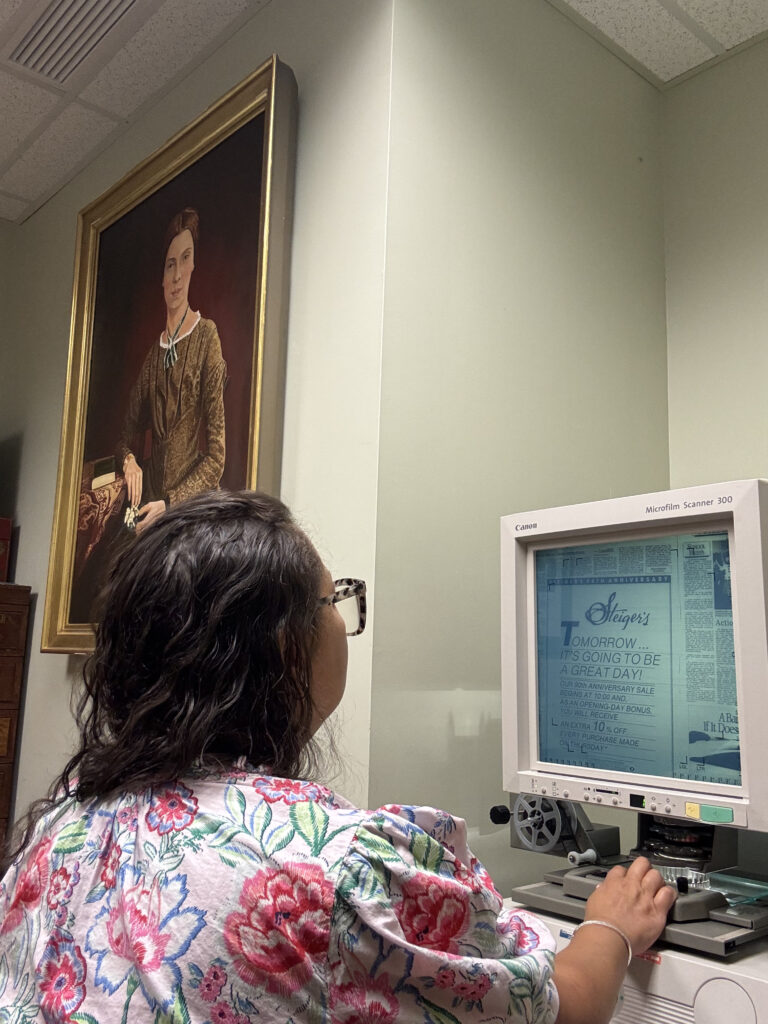
I went looking for my family’s history, Puerto Rican history and textile history in New England. I found so much, including a trip down memory lane to my own history in retail.
Driving through Hadley, past the Hampshire Mall where Steiger’s department store once stood, the store where I got my first job, I realized that the thread I have followed through this series, from Taíno cotton to the mundillo makers of Moca to the garment workers of New York, does not end at the factory door. It takes us to where I have spent much of the early part of my working life. On the sales floor. In the fitting room. With a person, a garment, and a mirror.
We will step behind that curtain next month. First, I want to take you to where the thread begins for me: the valley that raised me, the history that shaped it, and the people who made it home.
Where It Started
I grew up in Amherst, less than 2 miles from Hampshire College. My best friend’s parents worked and lived on campus, so its farm, its sheep, and its apple orchards were our playground. Years later, Hampshire would become my alma mater. But before that, I found a different classroom a few miles away.
A Valley Built on Fiber
What I didn’t understand as a child is that I was growing up in one of the great textile corridors in American history.
The Connecticut River powered the mills that made this region, and Holyoke was engineered around its canals as an industrial city. In 1874, after the Mill River Flood destroyed his operation in nearby Haydenville, an English-born silk manufacturer named William Skinner moved his company to Holyoke. By 1912, William Skinner and Sons ran what was described as the largest silk mill under one roof and the largest maker of satins in the world. Swatches of that silk sit today in the Smithsonian’s National Museum of American History. The mill ran until 1963.
The Store on High Street
Steiger’s began in 1896 on High Street in Holyoke, a few blocks from the canals that powered the city’s mills. Its founder, Albert Steiger, was a dry goods merchant born in Ravensburg, Germany. The business grew into a regional chain and became the last family-owned chain of department stores in New England. In 1978, one of its stores opened at the Hampshire Mall in Hadley. That store is where my own story in this industry begins, and I will tell it next month.
The mill is where fiber becomes fabric. The department store is where fabric becomes a life. Somebody’s first suit. Somebody’s wedding dress. Somebody’s coat for a winter they were not sure they would get through.
Then Came Us
So why does this corner of New England have one of the largest Puerto Rican communities anywhere outside the island? The answer runs through the fields.
After World War II, the U.S. Department of Labor ran what became known as the Puerto Rican Farm Labor Program. Between 1947 and 1990, it brought more than 400,000 Puerto Rican agricultural workers to the mainland. Many of them came to this valley, to the tobacco fields along the Connecticut River, sometimes earning as little as half the minimum wage.
The tobacco workers settled. They sent for their families. They moved from the fields into the mills, the factories, and the service jobs that held the region together, and they arrived just as the industry was leaving. Between 1955 and 1975, half of all industrial jobs in Holyoke disappeared.
They stayed anyway. They built Nueva Esperanza in 1982. They have marched in the Western Massachusetts Puerto Rican Parade every year since 1984. Today, Holyoke has the largest Puerto Rican population per capita of any city in the United States outside Puerto Rico. As of the 2020 census, 51.3 percent of the city is of Puerto Rican heritage.
Our Street
There is a point in Connecticut, driving north on 91, where something shifts. La bandera, hangs from rearview mirrors. Murals start to appear. Music comes through open windows. You feel yourself arrive somewhere before you can name it.
This summer I pulled off the highway onto Main Street in Holyoke, and I was not ready for what I felt.
Puerto Rican flags on storefronts and street signs, in murals, on license plates. People on folding chairs outside barber shops, just being with each other. I grew up coming to that street with my mother and my aunts, going in and out of the old factory buildings looking for lace and fabric, stopping at Medina’s Market, knowing people by name. My dad had a restaurant there. This was our street.
Being back on it after years in North Carolina, where that kind of density and fellowship is largely absent from my daily life, I felt something I can only describe as the body remembering where it came from.
And then you cross the bridge into South Hadley, and the shift is immediate. The last stretch of Holyoke before the bridge is the flats, the part of the city that carries the most visible weight of what years of disinvestment does to a community. We had family there too. I visited people in that neighborhood as a kid and never felt scared, because it was just where some of our people lived. The pride of Main Street and the oppression of the flats are not two different stories. They are one.
Family in the Story
My own family’s roots run through this history too. Two of my mother’s uncles grew up in Corozal, Puerto Rico, served as Borinqueneers in the 65th Infantry Regiment, and spent their later years in the Hartford area. Worcester honors the Borinqueneers with a memorial.
The people who worked the fields and the mills also stood behind the counters, stocked the back rooms, and hemmed the pants. Retail has always been one of the places where our community earned its living. I am part of that line.
Next month, Part 7 takes you behind the curtain: the sales floor at Steiger’s, the fitting room, and everything it taught me.
If your family’s roots run through Holyoke, Springfield, Hartford, or the tobacco fields in between, I want to hear that story. Send us an email. This research grows when we do it together.
Rosalinda Cruz is the founder of The Asor Collective, a sustainable fashion advisory and education practice based in North Carolina. She is currently developing Hilo, a book and documentary exploring the ancestral textile traditions of Puerto Rico.
A Note on Methodology:
The research informing this series moves through several layers of inquiry. It begins with cultural immersion, coursework, and the kind of observational knowing that comes from living inside a community and its history. It expands into archival aggregation, gathering documented sources, oral histories, and family narratives, with attention to the distinction between primary and secondary sources. It deepens through journalistic-level inquiry, including structured interviews with community practitioners, elders, scholars, and cultural workers, conducted in part through The Common Thread, my monthly long-form interview series. Where available, findings are grounded in peer-reviewed scholarship and institutionally documented sources, which are cited explicitly. Ancestral and community knowing is treated as evidence, not anecdote. It is sourced, named where possible, and held with the same care as any other form of documentation. This series does not claim to be academic research. It claims to be honest, sourced, and accountable to the communities it is about.
Sources referenced:
- Historic Deerfield, “Enduring Legacies of Puerto Rican Labor in the Connecticut River Valley”
- Joseph Carvalho III, “The Puerto Rican Community of Western Massachusetts, 1898 to 1960,” Historical Journal of Massachusetts, Westfield State University
- U.S. Census data on Holyoke’s Puerto Rican population, 2020
- Smithsonian National Museum of American History, William Skinner and Sons silk fabric lengths (1932)
- Wistariahurst Museum, Skinner Family Collection, Holyoke
- Holyoke Canal Tour, “Steiger Building”
- Rosalinda Cruz, “The Evolution of a New England Department Store,” The Asor Collective blog (November 2021)