
Hilo Part 2
By Rosalinda Cruz, Founder of The Asor Collective
There is a version of the sustainable fashion conversation that begins somewhere around the 1980’s. Conscious consumers, ethical sourcing, the slow fashion movement became more mainstream in the 1990’s from an activism perspective. And it really wasn’t until 2010 that the consumer became awakened. if you only read the mainstream press, you might believe that the idea of treating fiber with care and intention was invented by someone with a newsletter and a Substack.
It was not.
The knowledge at the center of this moment is ancient. It was cultivated by indigenous people around the world and on a Caribbean island centuries before the word “sustainability” existed. And most of the fashion industry has not acknowledged it.
This is the second post in a four-part series called Hilo (a spanish word meaning thread or yarn). If you’re just joining, I’d encourage you to start with Part 1, where I share the personal story behind why I went looking for this history in the first place.
Cotton, Before the Colonizers
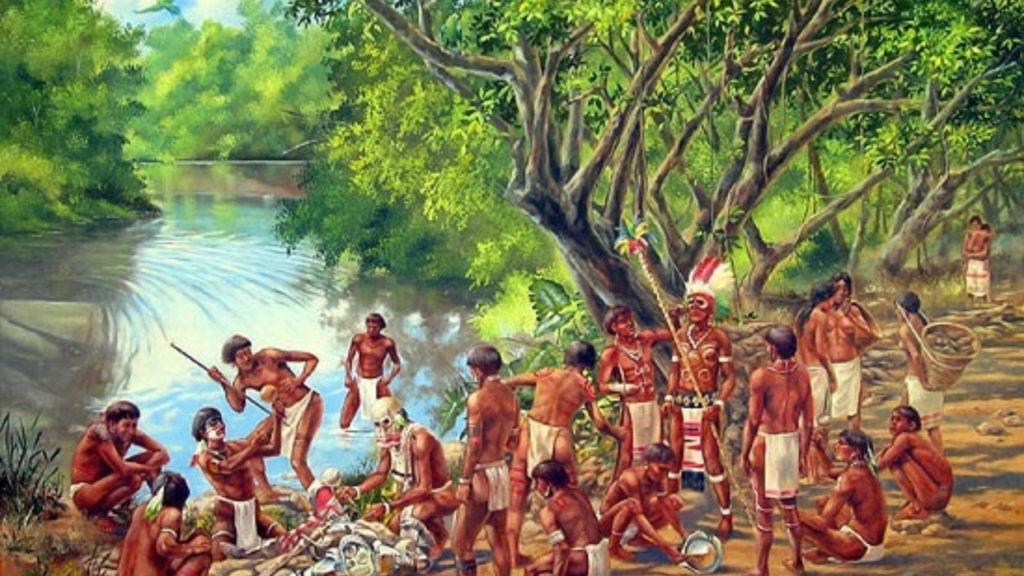
The Taíno people were the indigenous inhabitants of Borikén, the island we now call Puerto Rico and much of the wider Caribbean. According to the Smithsonian’s National Museum of the American Indian, they descended from Arawak-speaking peoples of South America who settled the Caribbean over 2,000 years ago. Their civilization stretched across Cuba, Hispaniola, Jamaica, Puerto Rico, the Virgin Islands, and the Bahamas. This is a regional inheritance, not a singular one.
The Kalinago known to colonial history as the Caribs, the people who gave the Caribbean Sea its name inhabited the Lesser Antilles to the east, with their own sophisticated traditions of fiber work and material culture. They and the Taíno were distinct peoples who nonetheless shared a Caribbean world through trade and contact. Puerto Rico, sitting at the boundary of both worlds, carries both histories.
When it comes to textiles and material culture specifically, the Taíno legacy is extraordinary.
They cultivated cotton. They wove it into clothing, hammocks, and fishing nets. They developed sophisticated agricultural systems, including the conuco, a raised-bed planting method that recent researchers are actively revisiting. A USDA-funded project is currently examining whether Taíno farming methods could help restore soil health and address food insecurity in Puerto Rico today. The people dismissed by colonizers as primitive were practicing regenerative agriculture centuries before the term existed.
I want to stop here and correct something I believed when I started this research, because I suspect I’m not alone in having believed it. I assumed Taíno cotton garments were plain. Simple woven cloth. Utilitarian.
They were not.
The Taíno cotton tradition was sophisticated, status-laden, spiritually deep, and intricately adorned. We know this because three extraordinary Taíno cotton artifacts have survived and what they show us is staggering.
The first is a woven cotton belt held at the Weltmuseum Wien in Vienna. Researchers describe it as “a complex woven structure, a wearable work of art,” incorporating indigenous shell beads alongside European mirrors, jet, and brass — all integrated within the weaving itself.
The second is the Pigorini cemí, held at the Museo Nazionale Preistorico Etnografico in Rome. It is constructed from Taíno hand-woven cotton fabric known in the scholarly literature by its Taíno name, sarobey alongside native seashell beads, seeds, European glass beads, circular mirrors, and a face mask carved from African rhinoceros horn. It is one of the most remarkable objects made by human hands in the Western Hemisphere.
The third is currently at the center of an active repatriation story, and I think it is the one that stops you cold. This cotton cemí was found in the Dominican Republic and eventually made its way to the University of Turin’s Museum of Anthropology and Ethnography in Italy. It is a sacred reliquary: it encases the cranium and mandible of a Taíno ancestor, with the full body reconstructed in woven cotton. An ancestor, held in textile. In October 2024, the Dominican Republic and Italy signed an agreement for it to be temporarily returned to the Dominican Republic on a six-month loan the DR Minister of Culture traveled to Italy personally for the signing. The Dominican Republic Embassy had been seeking its return for years. The question of permanent ownership remains unresolved.
That dispute is not separate from this story. It is the deepest version of it: who owns the knowledge, the materials, the objects, the ancestors. And the fact that this fiber cultivated by the Taíno for generations is what holds an ancestor’s body together in perpetuity tells you everything about what that material meant to them.
The nagua sits within this tradition. A woven cotton garment worn by married Taíno women, it marked status and identity a deliberate statement about who a woman was in her community. Crafted without looms. Just hands, knowledge, and skill passed down across generations with tremendous intention.
Cotton for the Taíno was not a raw material. It was a sacred one. They cultivated it, wove it, wore it, adorned it, and wrapped their dead in it. That is a relationship with fiber that the sustainable fashion industry is still trying to find words for.
And the work of bringing it back has already begun.
Reclamation
In 2017, Hurricane Maria devastated Puerto Rico and exposed something the island had long known but rarely said aloud: it was almost entirely dependent on imports for its basic needs, including food and textiles. In the aftermath, a Puerto Rican farmer named Yanna Muriel Mohan spoke at the Textile Exchange Sustainability Conference in Washington, D.C. Her words about the devastation moved the room. Within hours, Timberland had launched the Puerto Rico Cotton Fund. Eileen Fisher, Lenzing, and Westpoint Home contributed. Textile Exchange partnered with the Smallholder Farmers Alliance and Impact Farming to build something more lasting: a feasibility study for reintroducing organic cotton and natural fibers to Puerto Rico, with the vision of a local farm-to-fabric value chain.
Two reports came out of that work, an English version and a Spanish version both published in 2018. They document the conversations with Puerto Rican smallholder farmers, fashion designers, textile artists, and women-run cooperatives like Cooperative La Montaña. They document what was lost when the island’s cotton industry collapsed in the 1930s, and what it would take to bring it back. They also document the organizations on the ground already doing the work including Trama Agrocultura, a Puerto Rican natural fibers project that has been quietly building toward exactly this.
The Taíno cultivated cotton on this island for centuries. It was taken, commercialized, and then abandoned when it was no longer profitable for the people doing the taking. Now Puerto Rican farmers, designers, and cooperatives are asking for it back.
You’ve also been sleeping in their invention. The word “hammock” comes from the Taíno word hamaca. Columbus recorded it himself in his ship’s log on October 17, 1492, describing the nets the Taíno slept in as they traded cotton alongside his crew. That word and the object it named traveled from the Caribbean to European navies, and from there to the rest of the world. The Taíno built it. Everyone else borrowed it and moved on.
The Man Whose Name Many Have Forgotten
Here is a name I want you to hold onto: Fermín Tangüis.
Born in San Juan in 1851, Tangüis eventually made his way to Lima, Peru in his early twenties. By the turn of the century, Peru’s cotton industry was in crisis. A devastating fungus plague, known as cotton wilt, had swept through the fields, ruining farmers and collapsing one of the country’s most important economic pillars. According to records including his Wikipedia entry and the list of Puerto Rican scientists and inventors, Tangüis spent ten years in careful observation and experimentation: studying plants that showed resistance to the disease, collecting seeds, and attempting germination after germination. Most attempts failed. He kept going.
In 1911, after a decade of patient, methodical work, he developed a cotton seed that changed everything. The fiber it produced was 40 percent longer and thicker than what Peru had been growing before the plague. It resisted the disease. Where Egyptian cotton grew once a year, Tangüis cotton grows six times a year. He shared the seeds freely with other growers, who named the variety after him.
Tangüis cotton, known in Peru as Oro Blanco, White Gold, rescued the Peruvian cotton economy. By 1918 Peru was exporting it, and the revenues helped fund the national budget. By 1997, Tangüis cotton made up 75 percent of all Peruvian cotton production. It is listed to this day on the Liverpool Cotton Exchange.
A Puerto Rican man, working alone, in a country not his birthplace, with no institutional backing, spent ten years failing and kept trying anyway, and built something that sustained an entire nation’s textile industry for over a century.
Most people have never heard his name. Most Puerto Ricans have never heard his name.
That is exactly the kind of erasure this series is about.
Tangüis stands in a direct line between the Taíno people who cultivated cotton on Borikén before colonization and the global textile trade we know today. He is proof that Puerto Rican knowledge of fiber and agricultural science did not disappear under colonial pressure. It adapted, migrated, and quietly kept building.
Part 3: The Craftswomen, the women of Moca and the bobbin lace tradition that nearly disappeared coming next.
Rosalinda Cruz is the founder of The Asor Collective, a sustainable fashion advisory and education practice based in North Carolina. She is currently developing Hilo*, a documentary exploring the ancestral textile traditions of Puerto Rico.*
A Note on Methodology:
The research informing this series moves through several layers of inquiry. It begins with cultural immersion, coursework, and the kind of observational knowing that comes from living inside a community and its history. It expands into archival aggregation, gathering documented sources, oral histories, and family narratives, with attention to the distinction between primary and secondary sources. It deepens through journalistic-level inquiry, including structured interviews with community practitioners, elders, scholars, and cultural workers, conducted in part through The Common Thread, my monthly long-form interview series. Where available, findings are grounded in peer-reviewed scholarship and institutionally documented sources, which are cited explicitly. Ancestral and community knowing is treated as evidence, not anecdote. It is sourced, named where possible, and held with the same care as any other form of documentation. This series does not claim to be academic research. It claims to be honest, sourced, and accountable to the communities it is about.
Sources referenced:
- Smithsonian National Museum of the American Indian on Taíno history and ancestry
- Discover Puerto Rico, Taína Route: Indigenous Culture in Puerto Rico
- USDA SARE Grant GS23-287: “The Taino: Can Indigenous Agricultural Methods of Puerto Rico Feed the Island?”
- Columbus ship’s log, October 17, 1492 (via Wikipedia / Hammock etymological record)
- Wikipedia, “Fermín Tangüis”
- Wikipedia, “List of Puerto Rican Scientists and Inventors”
- Joanna Ostapkowicz, “‘Made With Admirable Artistry’: The Context, Manufacture and History of a Taíno Belt,” The Antiquaries Journal (Cambridge, 2013) on the Weltmuseum Wien cotton belt
- Florida Museum of Natural History, University of Florida, Taíno Society research page
- The Growing Dutchman / Smallholder Farmers Alliance, Puerto Rico Cotton Study (2018), English and Spanish editions: thegrowingdutchman.com/project/puertoriconaturalfiber
- WWD, “Timberland, Eileen Fisher Help Launch Puerto Rico Cotton Fund” (November 2017)
- Textile Exchange, Puerto Rico Cotton Fund documentation: textileexchange.org